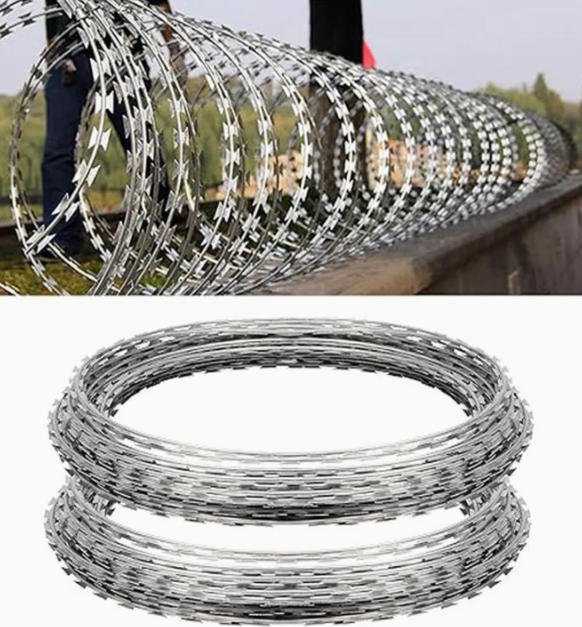
As security threats continue to evolve, the demand for effective and reliable perimeter protection has never been greater. Razor wire has emerged as one of the most widely adopted solutions in this field, offering a combination of physical deterrence, visual intimidation, and structural resilience that few other fencing products can match. The Design Behind Razor Wire Razor wire differs from conventional barbed wire in both appearance and function. While traditional barbed wire uses short pointed barbs twisted around the wire strands, razor wire features flat steel blades that are stamped and clipped around a central high-tensile core wire. These blades are sharp along their edges, creating a continuous cutting surface that is far more difficult to grip, cut, or push aside than simple pointed barbs. The core wire runs through the center of the blade tape, providing the structural backbone that keeps the product taut and stable under tension. This dual-component design — a strong core wire combined with sharp blade tape — is what gives razor wire its superior performance as a security barrier. How It Provides Protection Razor wire protects perimeters through a combination of physical and psychological deterrence. On the physical side, the sharp blades make it extremely painful and dangerous to attempt to climb over, cut through, or crawl under the barrier. The blade edges are designed to resist being bent or flattened, meaning that even sustained pressure is unlikely to create a passage. On the psychological side, the aggressive appearance of razor wire sends a clear message that the area is protected and that unauthorized entry will not be tolerated. Studies in crime prevention have consistently shown that visible security measures play a significant role in discouraging intrusion attempts before they even begin. When deployed in multiple layers or combined with other fencing systems, razor wire creates a defense-in-depth strategy that significantly increases the time and effort required to breach the perimeter — often making unauthorized entry practically impossible without specialized tools. Common Configurations Razor wire is manufactured in several configurations to suit different installation methods and security requirements. Concertina coils are the most widely recognized form. The wire is formed into large spiral coils that expand like a spring when deployed. Multiple coils can be clipped together to create a continuous barrier of considerable width and density. This configuration is especially popular in military and correctional facilities where maximum deterrence is required. Flat wrap coils are compressed into a flat, linear form that can be easily mounted on top of walls or fences. This type offers a cleaner appearance while still providing strong cutting-edge protection. It is commonly used in commercial and industrial settings where aesthetics matter alongside security. Straight-line strands are installed as individual tensioned wires along fence tops or between posts. This simpler configuration is suitable for applications where a less dense but still effective barrier is needed. Material Options and Longevity The durability of razor wire depends on the quality of materials and the type of surface treatment applied during manufacturing. Galvanized razor wire is the most common type. The steel blades and core wire are coated with zinc through hot-dip galvanizing, which provides robust protection against rust and corrosion. This makes it suitable for long-term outdoor use in a wide range of climates. PVC-coated razor wire adds a polymer layer over the galvanized core, offering enhanced resistance to moisture, chemicals, and ultraviolet radiation. The PVC coating also provides color options, with green being the most popular choice for blending with natural surroundings and black for industrial or urban environments. Stainless steel razor wire is available for specialized applications where extreme corrosion resistance is required, such as marine environments or chemical processing facilities. While more expensive, it offers the longest service life in harsh conditions. Where Razor Wire Is Used Razor wire is deployed in a broad range of settings where perimeter security is a priority. Military installations and defense facilities rely on razor wire to protect sensitive areas from unauthorized access. Correctional facilities use it extensively on perimeter walls and fences to prevent escapes and intrusions. Government buildings, embassies, and diplomatic compounds often incorporate razor wire as part of their layered security strategy. In the commercial sector, razor wire is used to protect warehouses, logistics centers, power stations, telecommunications facilities, and storage yards. Airports and seaports also use it to secure restricted zones and cargo areas. Even in agricultural settings, razor wire can be found protecting remote equipment, livestock facilities, and high-value crops from theft or damage. Installation and Maintenance Proper installation is essential for razor wire to perform effectively. The supporting fence or wall structure must be strong enough to bear the tension of the wire, and posts should be placed at appropriate intervals to prevent sagging. Concertina coils should be securely clipped together to prevent gaps, and all connections should be checked for tightness. Once installed, razor wire requires minimal maintenance. Periodic inspections should be conducted to check for loose clips, damaged blades, or corrosion, particularly in coastal or high-humidity environments. With proper installation and routine checks, a quality razor wire system can provide reliable security for many years. The Value of Razor Wire in Perimeter Security Razor wire continues to be one of the most trusted and widely used security fencing products in the world. Its effectiveness lies in the combination of sharp physical deterrence, strong visual presence, durable construction, and flexible installation options. Whether used as a standalone barrier or as part of a comprehensive security system, razor wire provides a practical and proven solution for protecting people, property, and assets.
Customer Reviews
Daniel Carter
Senior Procurement Manager
We purchased border fence and airport fence systems for multiple security projects. The product quality was consistent, and the supplier provided clear technical support throughout the process.
Kenji Nakamura
Project Engineer
The highway guardrail and bridge fence products met our engineering requirements perfectly. Material quality, surface treatment, and packaging all exceeded expectations.
Samuel Okafor
Operations Director
The electric fence and temporary fencing systems performed very well in our large-scale projects. Delivery was efficient, and communication remained smooth from production to shipment.
Emma Laurent
Purchasing Director
The municipal fencing and ornamental fence products offered both durability and aesthetic value. Customization options helped us meet diverse project requirements.
Frequently Asked Questions
We can connect you with trusted installation teams in many regions. Remote or on-site guidance from our technical staff can be arranged.
Standard lead time for border fence orders is 3–5 weeks after order approval, based on volume and project specifications. Priority service can be arranged.
Yes, standard border fence panels offer 3-year corrosion resistance under common outdoor conditions. Enhanced protective coatings are available upon request.
Our border fence systems are designed for wind loads up to 9 levels. Custom configurations can be arranged for specific terrain and project requirements.
Get In Touch
Ready to Discuss Your Project?
Send us your requirements today and receive fast support, product details, and factory pricing within 24 hours.
Call Us
+86 19358286056
Mon-Fri, 8am-6pm CST
Email Us
sales@fieldfence.me
We reply within 24 hours
WhatsApp
+86 19358286056
Instant messaging available
Our Address
South Area of Anping Industrial Park, Anping County, Hengshui City